
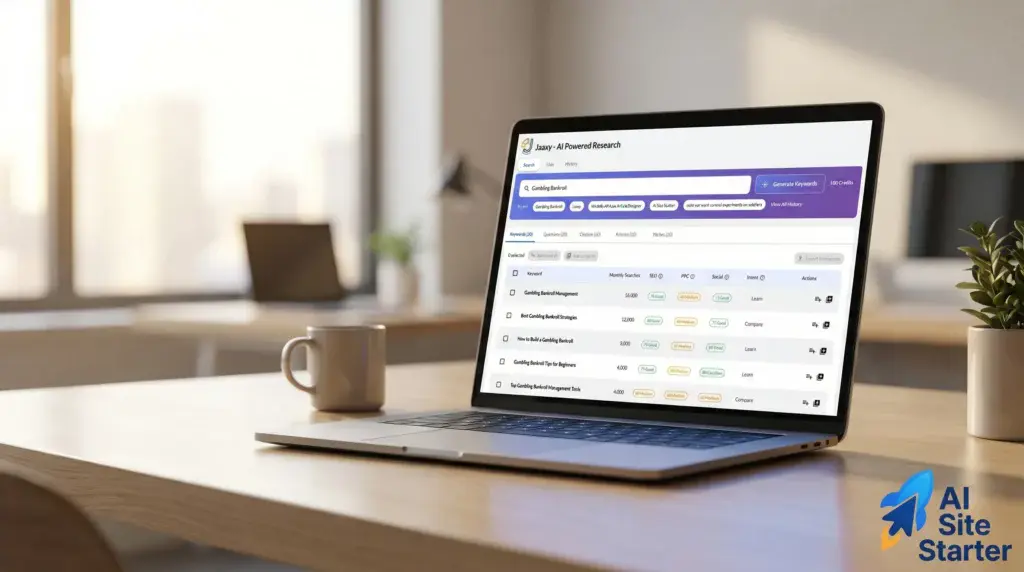
What Is Jaaxy Keyword Research? A Beginner-Friendly Walkthrough
When I first got started online, I didn’t know a keyword from a hole in my head.
I had ideas. I had motivation. What I didn’t have was any clue what people were actually typing into search engines.
That changed when I learned how to use Jaaxy keyword research through the training inside Wealthy Affiliate. Instead of guessing blog topics, I started choosing phrases based on real search data.
Now I use Jaaxy almost daily to find content ideas and long-tail keywords I actually have a chance to rank for.
If you’re brand new and the word “keyword” already sounds too technical, don’t worry. Let’s keep this simple and allow me to explain.
First, What Is a Keyword?
A keyword is just a phrase someone types into Google.
That’s it.
Examples:
- Best budget laptop for college
- How to lose weight walking
- Beginner guitar chords
Every one of those searches represents a real person looking for help, answers, or products.
Jaaxy helps you discover those phrases before you write your article, so you create content people are already searching for.
What Jaaxy Keyword Research Actually Shows You
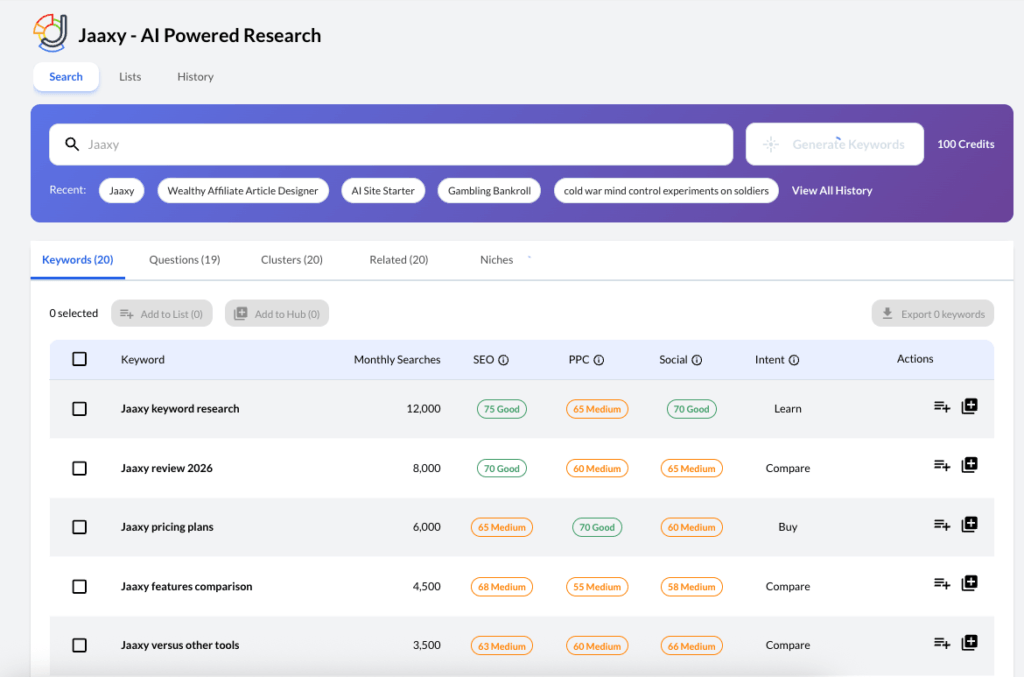
When you type a phrase into Jaaxy, it gives you a list of related keyword ideas along with several columns of data.
Here’s what each one means in plain English.
Monthly Searches
This is an estimate of how many times people search that phrase each month.
Higher numbers mean more demand. But bigger is not always better. Very high search volume often comes with heavier competition.
As a beginner, you’re looking for realistic traffic, not giant numbers you can’t compete with yet. Look for low competition keywords at first; they are easier to rank for, and as you grow, add higher volume ones. I would recommend 300-500 searches per month for a new blog. Ranking for low-volume keywords helps your site build authority over time.
SEO Score
This is one of the most important columns.
Jaaxy gives you a score and a label like:
- 85 Excellent
- 75 Good
- 60 Medium
This score estimates how difficult it would be to rank on page one for that keyword.
Higher score = easier opportunity.
When I started, I ignored this and chased high search volume. That was a mistake. Now I look at the SEO score, then at search volume. For beginners, you want a High SEO score and low search volume. I know that sounds crazy, but remember, I have learned what works because I have been where you are now.
PPC
This shows how competitive the keyword is in paid advertising.
Why does that matter to you?
Because advertisers usually bid on phrases that make money. If businesses are paying to show ads, there’s often buying intent behind that keyword.
You’re getting a little peek into the commercial value of a topic. As a beginner, this does not apply to you, but further down the road, this metric will be golden. You need to learn to walk before you can run!

Social
This suggests how well content around this topic tends to perform socially.
It’s not a ranking factor, but it gives you a sense of general interest and shareability.
Low social score doesn’t mean “bad keyword.” Many practical, buyer-focused keywords are not flashy or viral.
Intent
This is a powerful column for beginners.
Jaaxy labels what the searcher is likely trying to do:
- Learn
- Compare
- Buy
This tells you what kind of article you should write.
Learn keywords → tutorials, guides, step-by-step help
Compare keywords → feature breakdowns, pros and cons
Buy keywords → reviews, pricing, recommendations
Matching your article to intent is how traffic turns into clicks and commissions.
What the Jaaxy Screen Looks Like
How to Actually Choose a Good Keyword (Step by Step)
Here’s the simple process I use now.
First, I look at the SEO score. I prefer keywords labeled “Good” or “Excellent” when possible.
Second, I check Monthly Searches. I don’t need huge numbers. Even a few hundred searches per month can bring steady traffic.
Third, I look at Intent. If the keyword contains “Buy” or “Compare,” I know it has strong potential for affiliate content. If it says “Learn,” I focus on teaching and helping first.
Finally, I make sure the keyword fits my niche and is something I can genuinely write about in detail. I say genuinely, because if you are using AI writing software to create content, you need to add or inject your personal views into the article to make it unique.
That’s it. No complicated formulas.
What Beginners Should Avoid
This part would have saved me months when I started.
Avoid chasing only big search numbers. High volume often means high competition.
Avoid writing broad topics like “how to make money online.” Those are almost impossible for new sites to rank for.
Avoid ignoring intent. If someone wants to learn and you try to sell immediately, they’ll leave.
And avoid writing articles without first checking the keywords. That’s just guessing with extra steps.
How This Fits Into Your First 10 Articles
If you’re brand new, Jaaxy can guide your early content.
Instead of picking random topics, you build your first 10 articles around low-competition, clear-intent keywords.
That gives your site structure and provides Google with clear signals about what your site is about. And it gives you a real chance to start seeing traffic sooner instead of later.
That’s exactly how I started once I understood what I was doing.
The Bottom Line on Jaaxy Keyword Research
Jaaxy doesn’t guarantee rankings. No tool can.
What it does is help you stop guessing. It shows you where search demand already exists and where competition is more manageable.
You still have to write helpful content. You still have to be patient.
But now you’re aiming with data instead of throwing content into the void and hoping something sticks.
If you’re learning keyword research for the first time, Jaaxy is the tool that finally made it click for me. If you want to see how it works inside the full training platform, you can check it out here through the Wealthy Affiliate Starter Program. I will be on the other side to greet you once you complete your profile.
And once you understand keywords, content creation stops feeling random and starts feeling strategic.
Jaaxy Keyword Research Guide — FAQ
Straightforward answers to help beginners understand Jaaxy, keyword metrics, and how to choose keywords that can rank.
What is Jaaxy and what does it do? +
Jaaxy is a keyword research platform built to help marketers and bloggers find search terms with traffic potential and low competition. It analyzes search volume, competition, and ranking difficulty so you can choose keywords that are easier to rank. :contentReference[oaicite:0]{index=0}
Why is keyword research important for blogging? +
Keywords show what people are searching for. When your content matches those searches, search engines understand your topic and are more likely to display your page in results. :contentReference[oaicite:1]{index=1}
What do Jaaxy metrics like AVG, Traffic, and QSR mean? +
AVG shows monthly search volume, Traffic estimates potential visits, and QSR reveals how many competing pages target that keyword. These metrics help you balance demand and competition. :contentReference[oaicite:2]{index=2}
What is QSR and why does it matter? +
QSR (Quoted Search Results) shows the number of pages competing for the exact keyword. Lower QSR means less competition, making it easier for new sites to rank. :contentReference[oaicite:3]{index=3}
What is the Alphabet Soup feature in Jaaxy? +
Alphabet Soup generates keyword variations by combining your phrase with letters of the alphabet, revealing long-tail keyword ideas and content topics you may not have considered. :contentReference[oaicite:4]{index=4}
How do I choose a good keyword using Jaaxy? +
Look for keywords with clear intent, moderate search volume, and low competition. Avoid broad terms dominated by large sites and focus on specific phrases your audience actually searches. :contentReference[oaicite:5]{index=5}
Is Jaaxy suitable for beginners? +
Yes. Jaaxy is designed to be simple and fast, providing clear metrics and keyword suggestions that help beginners make informed SEO decisions without complex tools. :contentReference[oaicite:6]{index=6}
Can Jaaxy help me find new niche ideas? +
Yes. Features like Brainstorm and Alphabet Soup reveal trending searches and untapped niches, helping you discover content opportunities with less competition. :contentReference[oaicite:7]{index=7}




Great breakdown of Jaaxy, Michael, especially how you explained intent for beginners. I’ve found it helpful to use both the old and new versions together instead of treating the AI one as a complete replacement.
I mainly use Jaaxy AI for content planning and topic clustering. The intent labels are super useful. I turn Commercial intent keywords into main affiliate posts, and use the Learn intent keywords for supporting content around them. So I’ll build a cluster with one main affiliate article backed by 6–8 internal “feeder” posts. The Learn posts bring in broader traffic and warm people up, while the Commercial posts help with topical authority and (hopefully improve) conversions.
I still check the older Jaaxy view sometimes to reword ideas or verify that PAA-style questions are actual searches and not just algorithm suggestions.
The new vesrion, I find to be more of a site-structure tool than just a keyword tool. It fits perfectly with the intent-first method you’re describing. Great walkthrough of how Jaaxy Keyword Research tool works because it is far more than just some numbers.????
Hello, Robert, and thank you for taking the time to share your insights and comments on my article. I think that since the Google algorithm change, the improvements and advancements that have occurred in Jaaxy are both innovative and useful, given that we are now knee-deep in the age of search intent. I want to show my audience exactly how to leverage Jaaxy to its potential, and your remarks have shown me that I have done just that.
Thank you,
Michael