

AI prompt engineering is the practice of giving clear, structured instructions to an AI system so it produces useful, accurate, and relevant output.
That’s the simple version. The longer version is a bit more interesting.
At its core, prompt engineering is about communication. You’re not programming in the traditional sense. You’re guiding a language model using plain language. The quality of the result depends heavily on how well you explain what you want.
Think of it like asking a contractor for a quote.
If you say, “Fix my house,” you’ll get confusion.
If you say, “Replace the kitchen cabinets with white shaker style and install quartz countertops,” you’ll get something usable.
Same idea with AI.
Why Prompt Engineering Matters
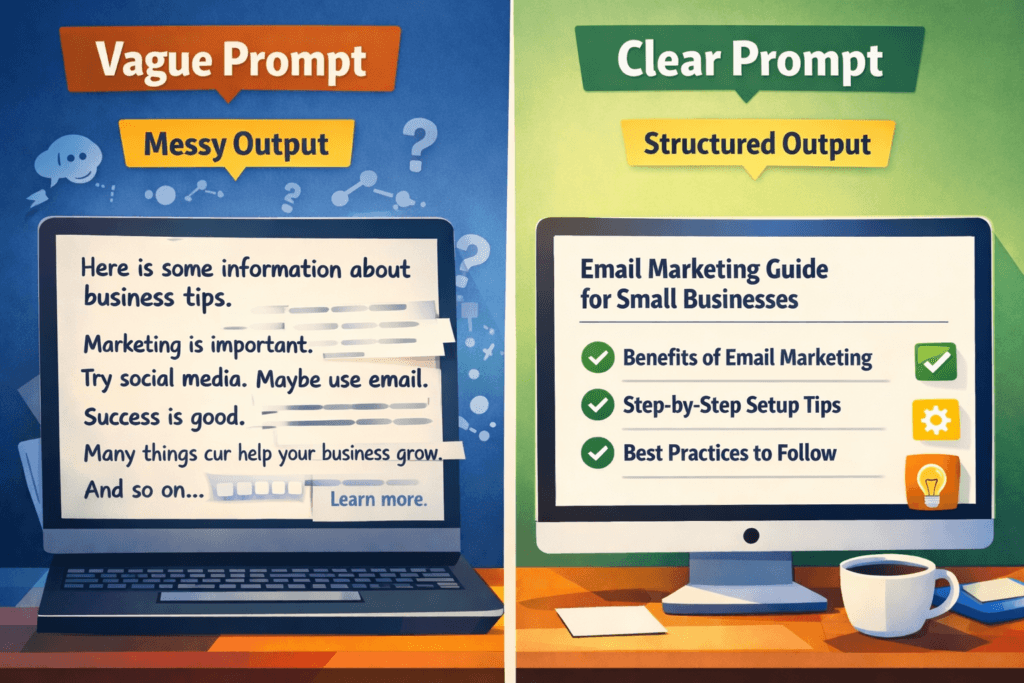
AI models don’t “know” your intent unless you state it. When prompts are vague, the model fills gaps with assumptions. That’s when you see generic answers, hallucinated details, or content that misses the point.
Clear prompts help you:
- Get more accurate results
- Reduce irrelevant output
- Control tone, format, and length
- Save time on revisions
It’s not about tricking the AI. It’s about removing ambiguity.
What Makes a Good Prompt
A strong prompt usually includes a few key elements:
- Role → Who the AI should act as
- Task → What you want it to do
- Context → Who it’s for and why
- Constraints → Limits like length, tone, or style
- Format → How the output should be structured
Example:
Act as a beginner-friendly tech writer. Explain AI prompt engineering in 300 words for small business owners. Use simple language and bullet points.
Compare that to:
Explain prompts.
Both work. Only one is useful.
Common Misconceptions
Myth: You need secret prompts to get good results.
Not true. Clear instructions beat “magic” templates.
Myth: Prompt engineering is only for developers.
Anyone using AI benefits from better prompts.
Myth: More words = better prompt.
Clarity matters more than length.
Where Prompt Engineering Shows Up
You’re using it anytime you ask AI to:
- Write blog posts
- Generate images
- Summarize documents
- Create marketing copy
- Build code snippets
- Brainstorm ideas
If you’ve ever rephrased a question to get a better answer, you’ve already done prompt engineering. You just didn’t call it that.
A Realistic Take
It’s not a mystical skill. It’s closer to learning how to ask better questions.
And oddly enough, once you get the hang of it, you start noticing how often poor instructions cause problems in everyday life, not just with AI.
That realization alone changes how you work.
Key Takeaway
AI prompt engineering is the skill of giving clear, structured instructions to AI systems so they produce accurate, relevant, and useful results.
AI Prompt Engineering FAQ
Quick answers to the most common beginner questions about AI prompt engineering, written for real-world use.
What is AI prompt engineering?
Is prompt engineering only for developers?
Why do vague prompts give generic answers?
What should a good prompt include?
- Task: what you want done
- Context: who it’s for and why
- Constraints: length, tone, what to avoid
- Format: bullets, steps, table, outline
Do you need “prompt packs” to get good results?
What’s the simplest way to improve AI outputs right now?
Learn to Build an Online Business Using AI
If you’re curious about turning AI-assisted content into a real website, Wealthy Affiliate offers step-by-step training, hosting, and tools in one place. It’s where many beginners learn how to test ideas, publish content, and grow something sustainable at their own pace.
Explore Wealthy Affiliate