

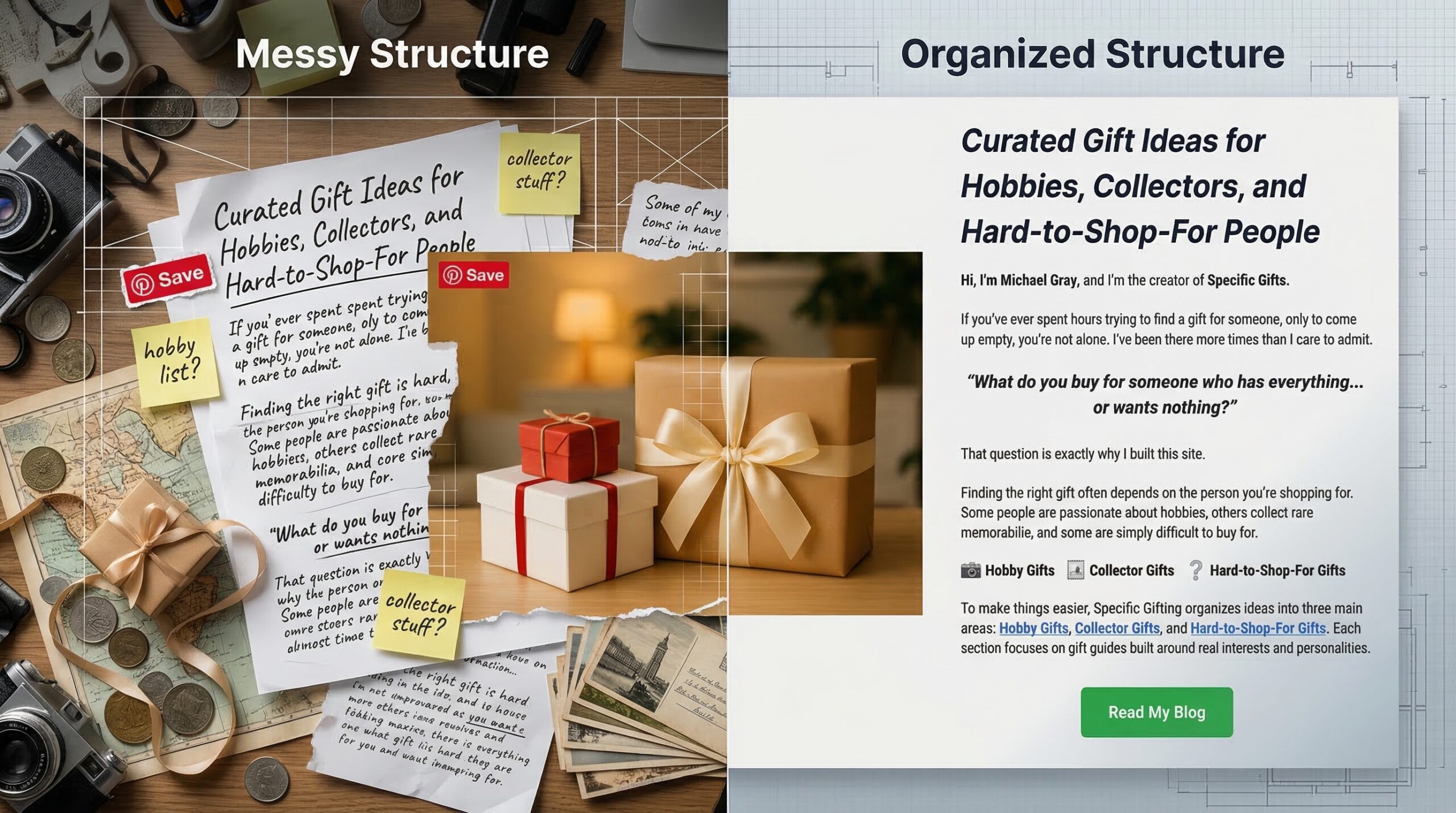
Most struggling sites do not need more content first. They need less mess.
That feels like the story of Specific Gifting on Day 2. The site exists to help people buy better gifts for hobby lovers, collectors, and those hard-to-shop-for people who make normal gift guides feel useless. That matters because most gift content online is too broad, too recycled, and too vague to help anyone make a real choice.
Day 2 was not flashy. It was practical. Categories got rebuilt, the menu got cleaned up, weak content got deleted, and 15 articles were reviewed for salvage potential. On top of that, stronger headings were drafted with RightBlogger, one new pillar post was added, one article got a better structure and FAQ, and the site moved from an odd SEO plugin to Yoast. In other words, the foundation finally looks usable.
Read the original article here: How I’m Bringing a Dead Website Back to Life With AI
Day 2 focused on cleaning up the site before chasing more traffic
When a site is mid-repair, structure usually matters more than reach. More traffic to a messy site just means more people hit confusing pages.
That is why this kind of cleanup makes sense early. Visitors need to trust what they see fast. On a gift site, that trust often starts with simple organization. If someone wants ideas for a vinyl collector or a dad with a niche hobby, they should not have to dig like they are searching through a junk drawer.
Specific Gifting is built around a smart idea, curated gift picks for real interests and real personalities. So the Day 2 work matched that goal. Rebuilding categories, cleaning the menu, and deleting useless content made the site easier to understand. It also made it easier to improve later.

It is not exciting work. That is sort of the point. A clear path beats a crowded one.
Early recovery work rarely looks impressive from the outside, but it often decides whether later SEO work sticks.
Clear categories help readers first, and search engines second. That order matters.
Gift sites work best when ideas are grouped around how people actually shop. Usually that means interest-based paths, like hobbies or collecting, and personality-based paths, like people who are tough to buy for. Those groupings feel natural because they mirror real shopping behavior.
A simpler menu also reduces friction. Readers can spot where to go next, and that lowers bounce risk. At the same time, search engines get cleaner clues about topic groupings. That does not guarantee rankings, of course, but it gives the site a more sensible shape.
Deleting weak pages was likely the right move
A lot of site owners hate deleting content. It feels like throwing away effort. Still, weak pages often drag the whole site down.
Thin posts, off-topic articles, and half-finished pages create noise. They confuse readers, split attention, and leave more dead ends to fix later. In contrast, a smaller set of better pages is easier to edit, link, and improve.
That seems to be the logic here. Instead of keeping every old post alive, Day 2 cut the dead weight. That probably saved time right away, and it gave the stronger pages more room to matter.
The content upgrade work started with the pages that still have potential
After cleanup, the next smart move is not a full content sprint. It is triage.
That is what happened here. The owner identified 15 articles that still seemed worth saving and started working through them one at a time. That middle step matters because it bridges the gap between cleanup and growth. You are not just removing problems anymore. You are rebuilding useful assets.
Part of that process included using RightBlogger to develop stronger headings. That is a simple win. Good headings help a post read better, scan better, and signal intent more clearly. One new pillar post also went live, which gives the site a stronger core topic page to build around. In addition, one older article got reworked with improved headings and a fresh FAQ section.

This is the kind of work that compounds. One better article rarely changes everything. Fifteen stronger articles, tied into a better structure, can.
There is also a broader lesson here for content sites in general. AI tools can help with outlines and cleanup, but they work best when the editor already knows the audience. That same idea shows up in this guide to AI tools for affiliate marketing beginners, where structure comes first and guessing gets cut out.
Refreshing headings and adding FAQs can make old posts more useful
Old posts often fail for boring reasons. The topic may be good, but the structure is muddy.
Stronger headings fix that. They break the article into clear chunks, show readers what is coming, and help search engines understand the page without a lot of guesswork. On a gift guide, that might mean clearer sections for budget, recipient type, hobby level, or gift safety.
FAQs help in a different way. They answer the last few doubts that stop people from choosing. For example, a reader might ask what to buy for someone who already owns all the basics, or whether a hobby gift should be practical or fun. Those are small questions, but they often hold up the sale, or at least the click.
A new pillar post gives the site a stronger center
A pillar post is just a strong, broad guide that supports smaller related articles. Nothing mystical about it.
For Specific Gifting, that kind of page can act like a home base for a topic cluster. Related posts can connect back to it, and future articles have a clearer place to belong. That makes growth easier later because the site stops feeling like a stack of random gift ideas.
I also brushed up an older post: Best Gifts for Homebrew Beer Lovers in 2026. I changed some information to bring it up to date. I added a Key Takeaway section as well as anFAQ with schema.

Switching to Yoast was a practical move, but the real win is consistency
Changing plugins is rarely the headline. Still, this one makes sense.
If the previous SEO plugin felt unfamiliar or clunky, it probably slowed down basic tasks. Yoast is a known system, and that matters. Familiar tools reduce second-guessing. They also make routine checks easier, like editing titles, reviewing meta descriptions, checking readability, and keeping sitemaps in place.
Why a familiar SEO setup can help a site recover faster
When a site owner already knows the tool, work tends to move faster. Small edits get done. Metadata gets checked. Posts get reviewed without friction.
As of March 2026, Yoast also includes newer features like Schema Aggregation in version 27.1, which can help search engines and AI systems read site relationships more clearly. That is helpful context, but it is not magic. A plugin cannot rescue thin pages or fix a weak structure on its own.
That is why Day 2 feels like progress, not a finish line. The real gains came from editing, pruning, organizing, and making the next steps easier to repeat. That same repeatable mindset sits behind these Wealthy Affiliate training modules, where systems matter more than shortcuts.
What Day 2 Actually Accomplished
Day 2 moved Specific Gifting in the right direction because it handled the plain, unglamorous work first. The site now has cleaner structure, less dead weight, a focused list of salvageable articles, better on-page content, a new pillar post, and a more familiar SEO setup with Yoast.
For AI Site Starter readers, that is the real takeaway. Site rebuilding usually starts with basic fixes done well, not dramatic hacks. Momentum often comes from clarity, and this cleanup created both. The site is not fully restored yet, but it finally has direction, and that is a much better place to build from.
Frequently Asked Questions
Why did Specific Gifting focus on cleanup before growth?
Specific Gifting focused on cleanup first because a messy site can confuse visitors and weaken future SEO efforts. Cleaning up categories, menus, and weak content created a better foundation before trying to attract more traffic.
Why is deleting weak content sometimes the right move?
Deleting weak content can help a site by removing thin, off-topic, or unfinished pages that create clutter. A smaller group of stronger pages is often easier to improve, link together, and trust as part of a clear site structure.
How do better categories and menus help a site grow?
Better categories and a simpler menu help readers find what they need faster. They also make it easier for search engines to understand how topics are grouped across the site, which can support stronger long-term SEO performance.
What was the purpose of reviewing 15 older articles?
Reviewing 15 older articles helped identify which posts still had value and could be improved. This kind of content triage saves time by focusing effort on pages that have a better chance of becoming useful assets again.
Why do stronger headings and FAQs matter on older posts?
Stronger headings make articles easier to scan and understand, while FAQs answer the small questions readers often have before taking action. Together, they can make an older post more useful, clearer, and easier to improve.
Why was switching to Yoast a practical decision?
Switching to Yoast was practical because it gave the site a more familiar SEO setup. Familiar tools make routine tasks easier, such as editing metadata, checking readability, managing sitemaps, and keeping optimization work consistent.
What is the main lesson from Specific Gifting Case Study Day 2?
The main lesson is that site recovery often starts with cleanup, not expansion. Clear structure, better organization, and stronger existing pages usually make future growth easier and more sustainable.