
What Is Agentic AI? A Beginner’s Guide to How Autonomous AI Systems Work
Artificial intelligence has moved fast in the last few years. At first, most people interacted with AI through simple prompts. You asked a question. The system answered. End of story.
Now a new idea is gaining traction in the AI world: agentic AI.
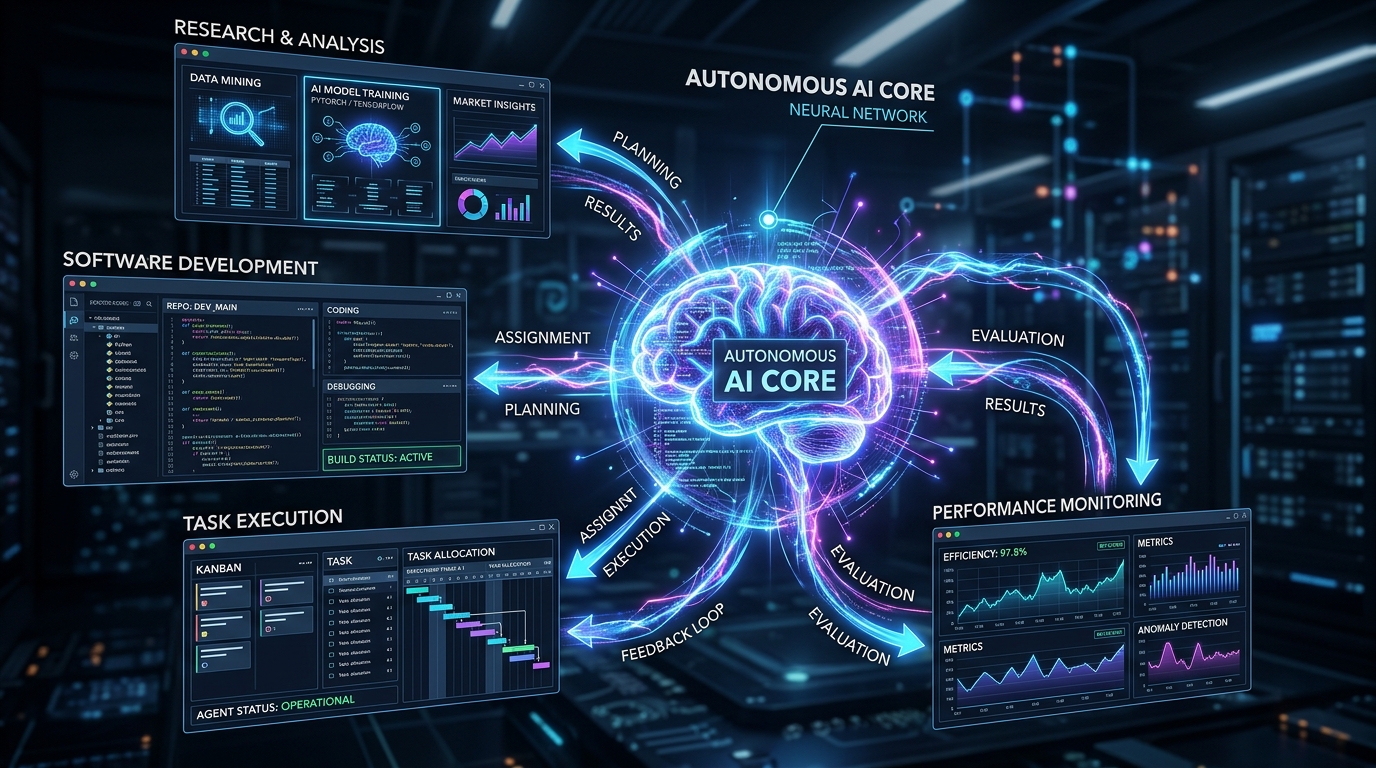
If you have spent any time around developers or AI tools recently, you have probably heard the phrase. It shows up in research papers, product announcements, and tech blogs almost weekly. The term sounds complex, but the core idea is actually pretty straightforward.
Agentic AI describes AI systems that can plan, make decisions, and take actions in order to complete a goal. Instead of answering a single question, these systems can work through a task step by step.
Think of it like the difference between asking a calculator a question and hiring an assistant.
A calculator gives you a result.
An assistant figures out what needs to be done.
Agentic AI sits much closer to the assistant side of that spectrum.
Understanding this shift matters because it is already changing how software works, how businesses automate tasks, and how creators build online systems.
The Evolution of AI: How We Reached Agentic Systems
To understand agentic AI, it helps to step back and look at how AI technology evolved.
Early software systems followed strict rules written by programmers. If a condition was true, the program performed a specific action. These systems were predictable but rigid.
Machine learning introduced a new approach. Instead of hard-coded rules, algorithms learned patterns from data. Systems could now recognize images, predict trends, and analyze information.
Generative AI pushed things even further. Large language models such as GPT could generate text, summarize information, and respond to complex prompts.
But even generative AI still worked mostly as a reactive tool. A user gave a prompt. The system responded.
Agentic AI changes the relationship.
Instead of reacting once, the system can plan a sequence of actions to reach a result.
This shift is small in theory but huge in practice.

What Agentic AI Actually Means
At its core, agentic AI refers to an AI system capable of autonomous goal-directed behavior.
That sounds academic, but it simply means the AI can:
• understand a goal
• plan steps to reach that goal
• choose tools or actions
• evaluate results
• repeat the process if necessary
The system becomes something closer to a problem solver rather than just an answer generator.
For example, imagine asking a traditional AI tool:
“Find good keywords for an article.”
You receive a list of keywords. That’s it.
Now imagine an agentic AI system handling the same task.
It might:
- Research a topic
- Analyze search trends
- Identify keyword gaps
- Suggest article ideas
- Outline the article
- Create draft content
- Evaluate SEO factors
The system performs multiple steps on its own rather than stopping after one answer.
That ability to reason through tasks is what makes agentic AI different.
Before publishing AI-assisted content, I like to run it through a quick quality check. I explain the process in my 5-Minute AI Content Test guide.
How Agentic AI Systems Work
Most agentic AI systems follow a repeating loop. The system receives a goal and works through several stages until the task is complete.
Below is a simple visual model of how the process works.
Agentic AI Workflow
Agentic AI Workflow
This cycle is often called the agent loop.
The AI does not simply produce one response. It keeps working until it reaches a useful outcome.
Many modern AI tools already experiment with versions of this loop.
The Core Components of an AI Agent
Behind the scenes, agentic AI systems usually rely on several important components.
These parts work together to create the behavior that feels “autonomous.”
Goal Definition
Every agent begins with a goal. This might be a user request or a system-generated task.
Without a clear goal, the agent has no direction.
Planning
The AI breaks the goal into smaller tasks. Planning helps the system figure out the most logical sequence of actions.
Tools
Many AI agents use tools to complete tasks. Tools might include:
• search engines
• APIs
• databases
• coding environments
• calculators
These tools expand what the AI can do.
Memory
Memory allows the system to remember past actions and results. Without memory, the agent would repeat the same mistakes over and over.
Some systems use short-term memory, while others use long-term knowledge storage.
Evaluation
After each step, the agent checks its progress. If something fails, the system can try another strategy.
This feedback loop makes the system more resilient.
Popular Frameworks Used to Build AI Agents
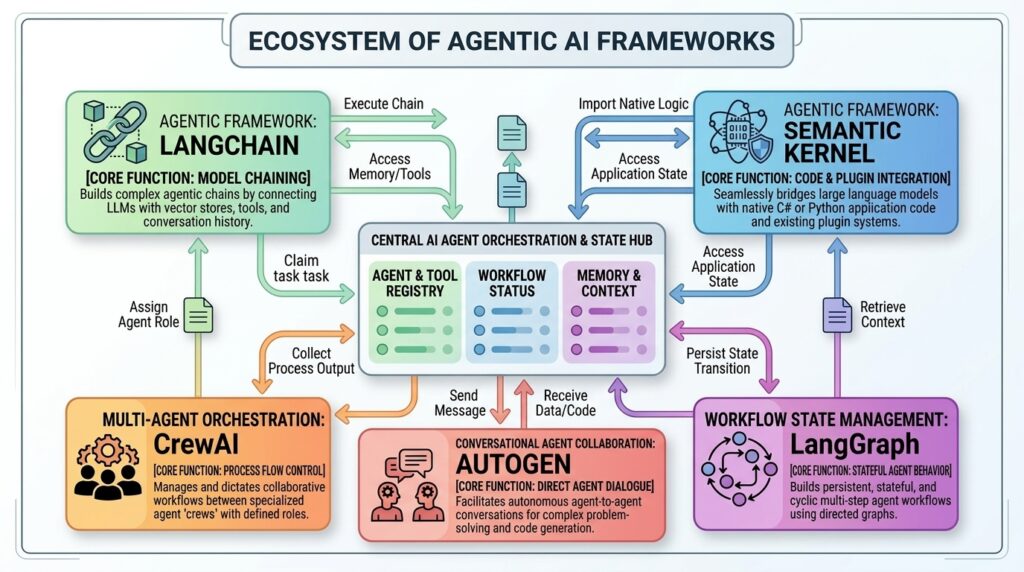
Several development frameworks now focus specifically on building agentic AI systems. Even if you are not a programmer, it helps to understand the ecosystem forming around these tools.
LangChain
LangChain is one of the most widely known frameworks for building AI applications. It helps developers connect language models with tools, data sources, and workflows.
Many early AI agents were built using LangChain because it simplifies the process of linking AI models to external systems.
CrewAI
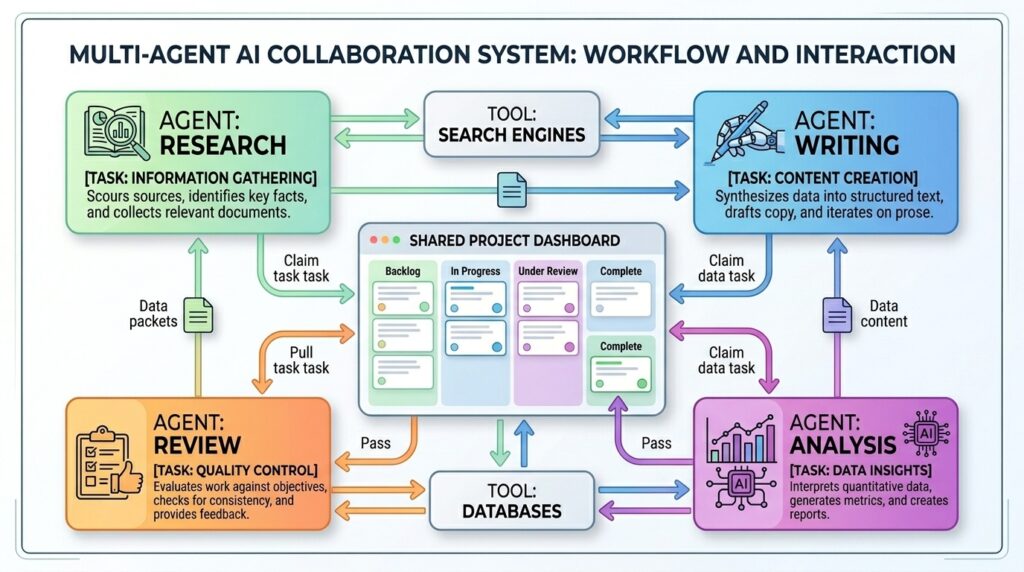
CrewAI focuses on multi-agent systems. Instead of a single AI agent performing tasks, several agents collaborate.
One agent might research a topic. Another might write content. A third might review results.
This structure mirrors how human teams often work.
Microsoft AutoGen
AutoGen is designed for building complex multi-agent conversations. Agents communicate with each other to solve problems, sometimes acting as specialists within a system.
LangGraph
LangGraph is built for more structured agent workflows. It allows developers to create AI systems with clear paths, branching logic, and defined task sequences.
Semantic Kernel
Microsoft’s Semantic Kernel framework focuses on integrating AI with traditional software systems. It is often used in enterprise automation projects.
These frameworks represent the growing infrastructure around agentic AI.
How Agentic AI Could Change Content Creation
For creators, marketers, and website builders, agentic AI may become one of the most interesting developments in the next few years.
Most content creators already use AI tools for writing assistance. But agentic systems take things further.
Imagine a system that can:
• research a topic
• identify keyword opportunities
• analyze competitors
• generate outlines
• draft content
• suggest internal links
• evaluate SEO performance
Instead of running several tools separately, the system manages the entire workflow.
Platforms like Wealthy Affiliate have already started integrating AI tools that help creators research niches, generate content ideas, and build websites faster. As agentic systems mature, tools like these may evolve into more automated content workflows.
The key difference is that the system handles multiple steps automatically rather than requiring constant manual prompts.
Real-World Use Cases for Agentic AI
Although the technology is still evolving, agentic AI already appears in several practical applications.
Automated Research
AI agents can collect information from multiple sources, summarize findings, and organize results.
Researchers and analysts use similar systems to speed up information gathering.
Coding Assistants
AI coding agents can analyze problems, write code, test solutions, and fix errors in cycles.
This process helps developers prototype software faster.
Customer Support
Some businesses use AI agents to handle customer questions. These systems can search documentation, retrieve information, and provide answers without human intervention.
Workflow Automation
Companies increasingly use AI agents to automate internal tasks such as scheduling, reporting, and data analysis.
As tools improve, these agents will likely handle more complex operations.
| Framework | Primary Purpose | Key Feature | Best For |
|---|---|---|---|
| LangChain | AI application development | Tool integrations and workflow chains | Developers building AI apps |
| CrewAI | Multi-agent collaboration | AI agents working as a coordinated team | Complex automation systems |
| Microsoft AutoGen | Agent communication frameworks | AI agents interacting with each other | Research and enterprise AI systems |
| LangGraph | Structured AI workflows | Graph-based agent logic | Advanced AI automation |
| Semantic Kernel | AI integration with software systems | Enterprise AI orchestration | Business automation |
Skills Needed to Understand Agentic AI
You do not need to be a machine learning researcher to understand agentic AI, but a few basic skills can help.
Understanding the following topics will make the concept clearer:
• basic AI and machine learning principles
• large language models
• APIs and automation tools
• prompt design
• workflow systems
For developers, programming languages such as Python are commonly used when building AI agents.
For creators and entrepreneurs, the focus is usually on using AI tools effectively rather than building them from scratch.
Why Agentic AI Matters for the Future of Software
The long-term impact of agentic AI could be significant.
Most software today requires users to perform tasks step by step. Agentic systems aim to reverse that relationship.
Instead of users navigating software menus, they simply describe a goal.
The system figures out the rest.
This shift could reshape how people interact with computers.
Some researchers believe that AI agents may eventually function like digital coworkers, assisting with research, analysis, and decision-making.
While that future is still developing, the building blocks already exist.
The Future of Agentic AI
Agentic AI remains an emerging field, but the momentum is clear.
New frameworks appear every few months. Technology companies invest heavily in autonomous AI research. Startups build products around multi-agent systems.
In the coming years, we will likely see agentic systems move into areas such as:
• business automation
• digital research assistants
• content production pipelines
• enterprise software operations
The concept may still feel experimental today, but it represents a major step in how AI systems interact with the world.
Understanding agentic AI now provides a useful window into where artificial intelligence may go next.
If you are exploring AI tools, building websites, or experimenting with automation, this is a topic worth watching closely.
Because once AI systems stop simply answering questions and start working toward goals, the entire relationship between humans and software begins to change.
And we are only at the beginning of that shift.
Agentic AI FAQ
What is agentic AI?
Agentic AI refers to artificial intelligence systems that can plan, make decisions, and take actions in order to achieve a goal. Unlike traditional AI tools that respond to a single prompt, agentic systems can perform multi-step tasks by planning actions, using tools, evaluating results, and repeating the process until the objective is complete.
How is agentic AI different from generative AI?
Generative AI focuses on creating content such as text, images, or code based on a prompt. Agentic AI goes further by combining generative models with planning systems, memory, and external tools. This allows the AI to complete complex tasks through multiple steps instead of producing only a single response.
What are AI agents?
AI agents are software systems powered by artificial intelligence that can perform actions to achieve specific goals. They often use large language models, memory systems, and external tools to plan and execute tasks. Agentic AI systems usually rely on one or more AI agents working together.
What frameworks are used to build agentic AI systems?
Developers often use frameworks such as LangChain, CrewAI, Microsoft AutoGen, LangGraph, and Semantic Kernel to build agentic AI systems. These frameworks help connect language models to tools, memory systems, and workflows that allow AI agents to perform complex tasks.
What are real-world uses for agentic AI?
Agentic AI is used in many areas including automated research, coding assistants, workflow automation, customer support systems, and marketing analysis. These systems can break large tasks into smaller steps and work toward completing them with minimal human supervision.
Do you need programming skills to use agentic AI?
Not always. While developers often build AI agents using programming frameworks, many modern AI platforms are beginning to integrate agent-like automation features that allow non-programmers to use them for research, content creation, and workflow automation.