

Today we will learn to write AI prompts that work, so let’s get this out of the way: your AI isn’t dumb.
It’s confused.
You typed something like “write something about my business,” hit enter, and got back a beige wall of text that could double as sleep aid audio. Now you’re staring at the screen like the tool personally betrayed you.
It didn’t. You gave it fog and expected a map.
Good prompts aren’t magic. They’re instructions. And most of us are terrible at giving instructions unless we’re assembling furniture and quietly losing our will to live.
Why Your Prompts Keep Producing Bland Mush
AI fills in blanks with safe guesses. If you don’t tell it who the content is for, what the goal is, or how it should look, it defaults to generic, harmless, and painfully average.
Common prompt crimes:
- No audience
- No purpose
- No boundaries
- Expecting the AI to read your mind
We’ve all done at least three of these before breakfast.
The Secret Formula (That Isn’t Secret)
In order to write AI prompts that work, you don’t need a sacred scroll of prompts. You need four things:
Task + Context + Constraints + Format
That’s it. No rituals required.
Weak prompt Example
Explain SEO.
Better prompt Example
Explain local SEO to a restaurant owner who thinks hashtags improve Google rankings. Keep it under 400 words and include a checklist.
One of these teaches something. The other belongs on page 9 of a PDF nobody finishes.
Step-by-Step: How to Write AI Prompts That Work
1. Start with the task
What do you want the AI to actually do?
- Explain
- Write
- Summarize
- Compare
If you don’t know the task, the AI is just guessing.
2. Add context
Who is this for?
- Beginners
- Small business owners
- People who hate tech
- U.S. readers
Without context, you get content for “everyone,” which means it helps no one.
3. Set constraints
Constraints keep things from turning into a novel.
- 500 words
- Avoid technical language
- Friendly tone
- Include examples
Otherwise, you’ll get a keynote speech when you asked for a sticky note.
4. Specify the format
Format makes the output usable.
- Bullet points
- Checklist
- FAQ
- Step-by-step
This is the difference between “draft” and “publishable.”
A Real-World Example That Actually Happens
Let’s skip the tired marketing examples. Nobody wakes up thinking, “I need a blog post about marketing.”
They think, “Why is my site getting zero traffic?”
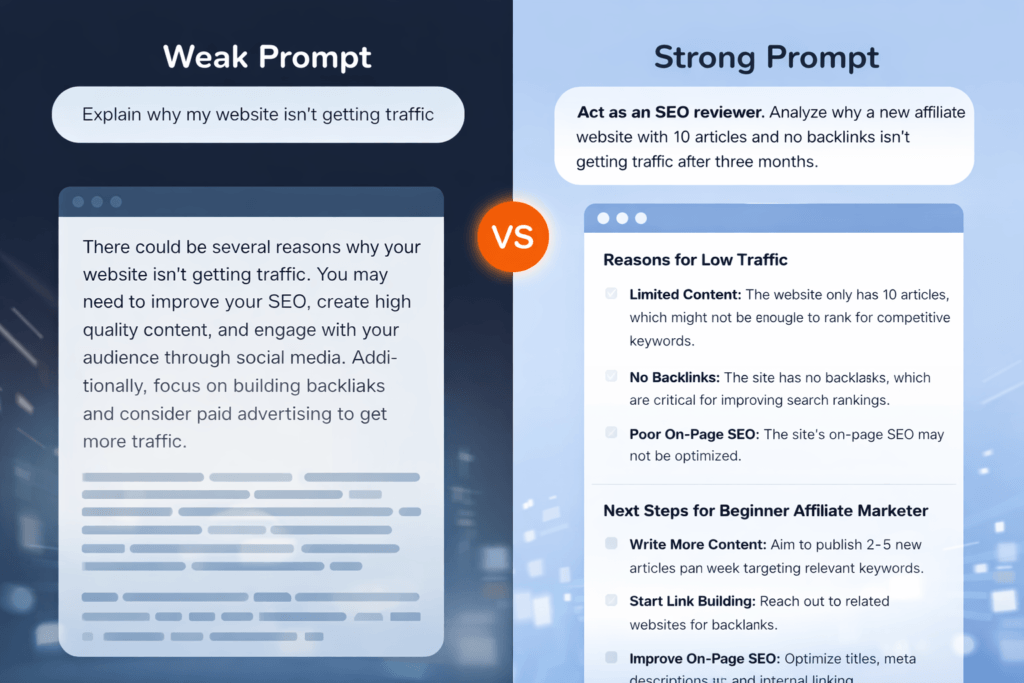
Weak prompt
Explain why my website isn’t getting traffic.
Sounds reasonable. It’s also useless. The AI has no context, no details, and no clue what you’ve tried. You’ll get advice like “improve SEO” and “create quality content.” Riveting. (Not Really)
Strong prompt
Act as an SEO reviewer. Analyze why a new affiliate website with 10 articles and no backlinks isn’t getting traffic after three months. Provide a prioritized list of realistic next steps for a beginner.
Now we’re getting somewhere.
The AI knows:
- Role: SEO reviewer
- Context: new affiliate site, 10 articles, no backlinks
- Timeline: three months
- Audience: beginner
- Output: prioritized next steps
That’s not just an answer. That’s a plan.
And yes, this sounds suspiciously like something typed at 11:38 p.m. after checking analytics for the fifth time.
Iteration: The Part Everyone Skips
Nobody writes the perfect prompt on the first try. You won’t. I won’t. Even the person selling a $49 prompt pack with a sports car they don’t own won’t. (The Online Gurus, If you know, then you know)
The real process:
- Notice what’s off
- Clarify
- Run the prompt
- Run it again
Two passes beat one “perfect” prompt every time.
Common Mistakes (Yes, You’ve Made These)
- Trying to sound clever instead of clear
- Stuffing the prompt with every idea you’ve ever had
- Forgetting to define the audience
- Expecting one prompt to do everything
Simple steps win more often than we’d like to admit.
Here is another article I wrote for my friends at Wealthy Affiliate. Bad Prompts Ruin GPT Results, Fix Them Fast (2026)
Do You Need Prompt Templates?
They can help. You save time. New ideas show up faster.
Most templates are built on the same structure you just learned. Once you understand that, you can write your own faster than you can scroll through a marketplace.
What does this mean? Save your money and do not invest in the magic prompt library people often try to sell you. Not only do they quickly become irrelevant, it is easy to create your own, more advance, focused and useful prompts.
That’s when AI stops feeling like a novelty and starts feeling like a tool you actually trust.
A Prompt You Can Steal Right Now
If you’re stuck, use this:
Write a [type of content] for [audience] explaining [topic]. Use [tone/style] and include [format].
Example:
Write a beginner-friendly guide for small business owners explaining how to use AI for blog content. Include a checklist.
It’s not fancy. It works.
Try This Before You Blame the Tool
Take one vague prompt you’ve used before. The lazy one. The “let’s see what happens” one.
Now add:
- Who it’s for
- What you want
- How it should look
Run it again.
If the result is better, congratulations. You’ve just discovered that the problem was never the AI.
It was the instructions. You can learn more about prompt engineering in my article. What is prompt engineering?
Key Takeaway
Writing AI prompts that work is about clarity, context, and structure, and small changes in how you ask lead to dramatically better results.
FAQ: Writing AI Prompts That Work
Straight answers to common questions about writing prompts that produce clear, useful AI output.