
Artificial intelligence is changing quickly.
Most people are familiar with chatbots and AI writing tools. You type a prompt, the system gives an answer, and the interaction ends.
AI agents work differently.
Instead of producing a single response, an AI agent can take actions, use tools, and continue working until a task is finished. That shift turns artificial intelligence from a simple assistant into something closer to a digital worker.
Understanding how AI agents function helps explain why agentic AI is becoming such an important topic.
What Is an AI Agent?
An AI agent is a software system that can perceive information, make decisions, and take actions to achieve a goal.
In simple terms, an agent does more than answer questions. It can work through a series of steps in order to complete a task.
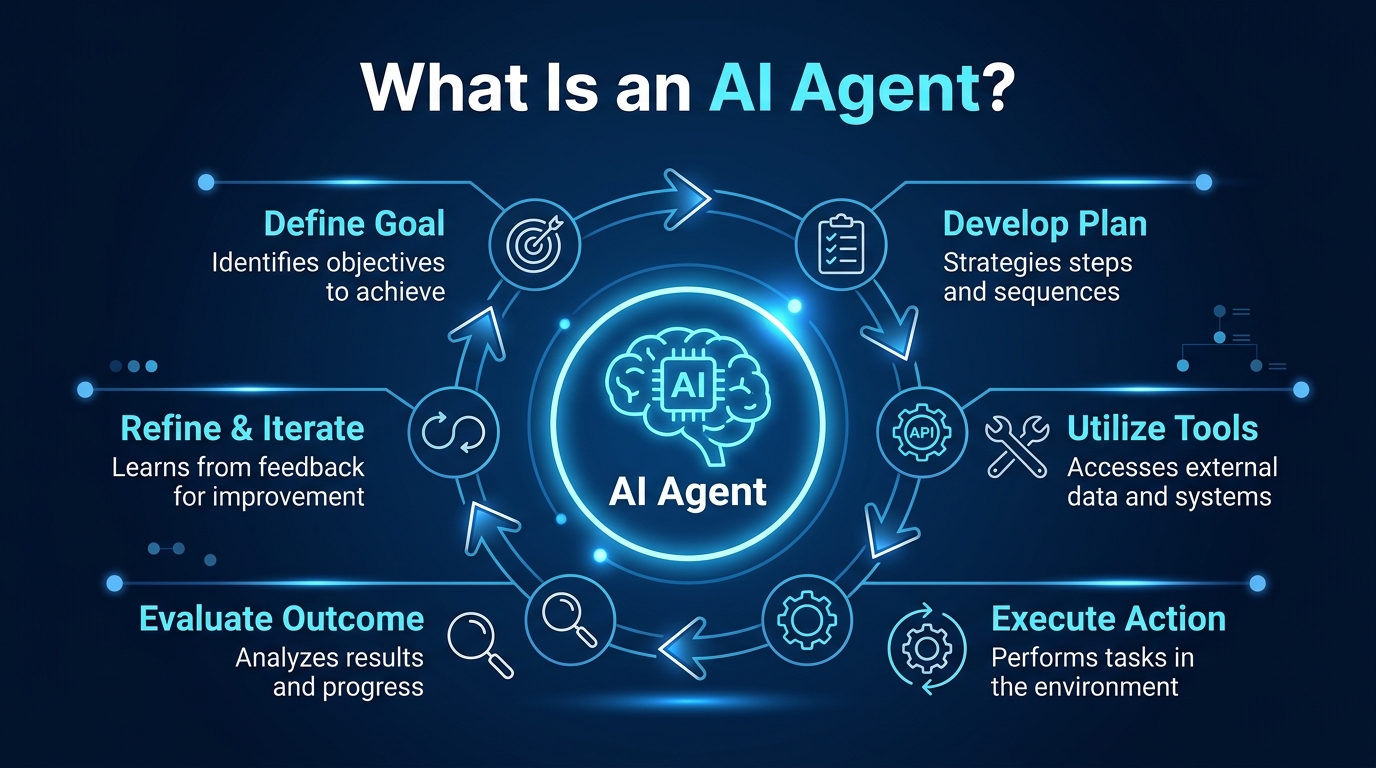
A typical AI agent follows a loop that looks something like this:
- receive a goal or instruction
- analyze the situation
- decide what action to take
- use tools or software if needed
- evaluate the result
- continue working until the task is complete
This ability to operate in a cycle of planning and action is what separates agents from traditional AI tools.
AI Agents vs Chatbots
Many people assume chatbots and AI agents are the same thing. They are related, but they behave differently.
A chatbot usually waits for a prompt. It generates an answer based on the information it was trained on and then stops.
An AI agent can continue working after the first response. It can gather information, use tools, and adjust its actions based on results.
Think of it this way.
A chatbot answers a question.
An AI agent attempts to solve the problem behind the question.
That difference may seem small, but it opens the door to much more complex automation.
How AI Agents Work
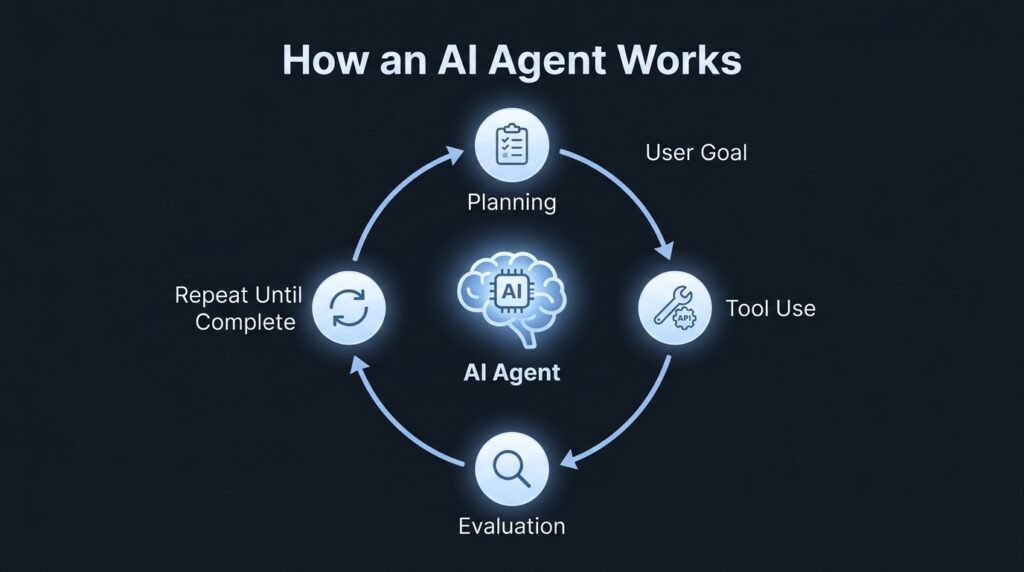
Behind the scenes, most AI agents rely on large language models combined with tool integrations.
The language model handles reasoning and decision making. Tools allow the system to interact with the outside world.
Those tools might include:
- web search engines
- databases
- APIs
- software applications
- automation platforms
When the agent receives a task, it decides which tools to use and in what order.
For example, a research agent might:
- search the web for sources
- extract key information
- summarize the findings
- organize them into a report
The agent continues running this workflow until the task reaches a satisfactory result.
Single Agents vs Multi-Agent Systems
Some AI systems rely on a single agent that manages the entire workflow.
Others use multiple agents that collaborate together.
In a multi-agent system, each agent has a specialized role. One agent might focus on research while another handles writing and another performs analysis.
These agents communicate with each other and coordinate their actions.
This approach allows complex tasks to be divided into smaller responsibilities, similar to how a team of humans might work together.
Multi-agent systems are one of the key ideas behind agentic AI.
Real Examples of AI Agents
AI agents are already being used in several areas.
Research assistants
Some AI systems can search the web, gather information from multiple sources, and assemble summaries.
Coding assistants
Developer tools can write code, test it, identify errors, and suggest fixes.
Customer support automation
AI agents can read support tickets, pull information from databases, and respond to customers.
Content workflows
Agents can research topics, create outlines, generate drafts, and schedule publishing tasks.
These systems are still evolving, but they show how AI is moving beyond simple text generation.
Why AI Agents Matter for Creators
For creators, bloggers, and online entrepreneurs, AI agents could eventually change how content workflows operate.
Today, AI tools mostly help with individual tasks such as writing, summarizing, or generating images.
Agent-based systems aim to automate entire processes.
Instead of writing prompts for each step, you might give an AI system a goal such as researching a topic, writing an article, generating graphics, and preparing it for publication.
The agent would then handle the workflow.
This idea is closely connected to a broader concept known as agentic AI, where multiple agents coordinate actions to achieve larger goals.
If you want to explore that concept further, read the full guide here:
Understanding these systems early can help creators prepare for a future where AI does much more than assist with content creation.
AI Agent FAQ
What is an AI agent?
An AI agent is a software system that can analyze information, make decisions, and take actions to complete a goal. Unlike basic AI tools that respond once to a prompt, AI agents can continue working through multiple steps until a task is finished.
How does an AI agent work?
An AI agent typically follows a loop of actions. It receives a goal, plans how to complete the task, uses tools such as web search or APIs, evaluates the results, and repeats the process until the goal is achieved.
What is the difference between an AI agent and a chatbot?
A chatbot usually responds to a prompt with a single answer. An AI agent can continue working after the first response by gathering information, using tools, and completing multi-step tasks.
What are examples of AI agents?
Examples of AI agents include research assistants that gather information online, coding assistants that write and test software, customer support systems that manage tickets automatically, and automation tools that run marketing workflows.
Why are AI agents important?
AI agents are important because they allow artificial intelligence to move beyond single responses and complete complex tasks. This capability is the foundation of agentic AI systems that automate workflows and assist with real work.